
District of Columbia DC DMV Permit Practice Test 29
- Questions25
- Correct to pass20
- Passing score80%
- Minimum age16 years
-
1. Your light turns green while a pedestrian who started on the walk signal is still crossing in front of you. What must you do?
Show answer
Answer D: Let them finish crossing the road before you move off on your green light
A pedestrian who entered the crosswalk lawfully keeps the right of way until they reach the other side, whatever the signal now shows.
-
2. Why are sign shapes and colors standardized across the whole country?
Show answer
Answer D: So a driver knows the kind of message before reading it
Uniform shapes and colors let a driver classify a sign as regulatory, warning or guide from a distance, before the legend can be read.
-
3. At night you are waiting to turn left and can see only the headlights of an approaching vehicle. Why should you allow a bigger margin?
Show answer
Answer D: Because lights alone make speed and distance hard to judge
With no other visual cues, two points of light give you very little information about how fast the vehicle is closing, so leave extra margin.
-
4. A pedestrian waiting at a curb faces a steady upraised hand. What does that indication mean?
Show answer
Answer A: Do not start to cross in that direction
A steady upraised hand forbids entering the crosswalk, while a flashing hand only forbids starting a new crossing.
-
5. A yellow curve warning sign carries a yellow plaque showing a speed. What does that number mean?
Show answer
Answer D: The recommended maximum safe speed for the curve under ideal conditions
An advisory speed plaque on a yellow warning sign gives the recommended maximum speed for the hazard ahead when conditions are good.
-
6. You are traveling at the same speed as a vehicle in the next lane, just behind its rear door. What should you do?
Show answer
Answer B: Change your speed so that you leave that driver's blind spot
That position is the classic blind spot. Slow slightly or move ahead so the other driver can see you before deciding to change lanes.
-
7. You are turning right where a paved trail crosses the road just past the corner. What should you look for?
Show answer
Answer B: Cyclists and walkers arriving from either direction on the trail
A shared use path carries two-way traffic on foot and on bicycles, so scan both directions along the trail before crossing it.
-
8. At roughly what speed can hydroplaning begin when a lot of water is lying on the road?
Show answer
Answer C: At speeds as low as about 35 mph
With enough water and less than perfect tread, a tire can start to ride on the water at around 35 mph, well below normal highway speeds.
-
9. What should you do before you back out of your own driveway at home?
Show answer
Answer A: Walk around the vehicle and check behind it for children or objects
A small child, a bicycle or a toy can sit entirely inside the blind area behind a vehicle, and a walk-around is the only way to be sure it is clear.
-
10. On a narrow residential street, why does parking tight against the curb matter so much?
Show answer
Answer C: Because fire trucks and ambulances need the width to get through
Cars parked even a foot out from the curb on both sides can narrow a street until a fire truck or ambulance cannot pass.
-
11. Something rolls off the seat onto the floor while you are driving. What should you do?
Show answer
Answer C: Leave it where it is and pick it up after you stop somewhere safe
Reaching for an object pulls your eyes and your body away from the controls at exactly the wrong moment, and nothing on the floor is worth that risk.
-
12. The cars in front of and behind your parallel parked car have left you very little room. How do you get out?
Show answer
Answer D: Ease back and forth, turning the wheels each way, until you clear
Short movements with the wheels turned first one way and then the other walk the car out of a tight space without touching anything.
-
13. You are approaching a horse and rider on a country road. What about your horn?
Show answer
Answer C: Do not sound it at all, because the noise can frighten the animal
A startled horse is dangerous to its rider and to you, so pass wide and slow and leave the horn alone.
-
14. You are in the right-hand of two left-turn lanes and the vehicle beside you starts to drift toward your lane during the turn. What should you do?
Show answer
Answer B: Slow slightly, keep to your own lane and give the other vehicle room
Drivers commonly drift wide in dual turn lanes, so hold your own line, ease off and leave space rather than racing or crowding the other vehicle.
-
15. Why does a long downhill grade lengthen the distance you need to stop?
Show answer
Answer C: Because gravity keeps pulling the vehicle forward as you brake
On a downgrade gravity works with the vehicle and against the brakes, so the same speed needs noticeably more distance than it would on level ground.
-
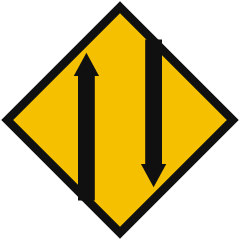
16. Which action becomes clearly more risky beyond this sign?
Show answer
Answer A: Using the left side of the roadway to overtake
With vehicles coming the other way on the same pavement, overtaking on the left needs enough clear road to pull out, pass and return, which is often not available.
-
17. You are starting from a stop on a snowy, icy street and the drive wheels begin to spin. What should you do?
Show answer
Answer C: Ease off the accelerator and start again more gently
Spinning tires polish the surface and dig in. Very gentle pressure on the accelerator, and a higher gear if you have one, gives the tires the best chance to grip.
-
18. You are circulating in a roundabout and a vehicle is waiting to enter ahead of you. What should you do?
Show answer
Answer D: Keep going, because circulating traffic does not stop for entering vehicles
Stopping in the circle to be polite surprises the drivers behind you and defeats the design; entering traffic is the side that waits.
-
19. An overhead sign shows that the right lane is EXIT ONLY. What does that mean if you intend to stay on the highway?
Show answer
Answer B: You have to move out of that lane before the exit
An exit only lane leaves the highway completely, so a driver continuing on the highway has to change lanes before it does.
-
20. A vehicle in front of you has already begun turning left into a driveway when the gap you were waiting for opens up. What should you do?
Show answer
Answer B: Wait and let that driver finish the turn
A vehicle that has lawfully started a maneuver keeps the right of way until it is finished.
-
21. You are waiting to turn left and a motorcycle is approaching from the opposite direction. Why should you take extra care judging its speed and distance?
Show answer
Answer A: Its small size makes it look farther away and slower than it really is
A motorcycle's narrow profile fools the eye, so drivers often misjudge how soon it will arrive. Left turns across an oncoming motorcycle are a leading cause of rider deaths.
-
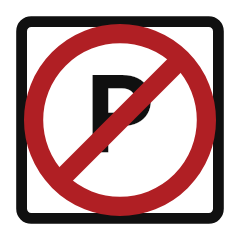
22. A driver leaves the vehicle at the curb where this sign is posted and walks away for two minutes. Is that allowed?
Show answer
Answer B: No, leaving the vehicle unattended there is prohibited whatever the length of the absence
Walking away leaves the vehicle parked, and the prohibition holds regardless of how long the driver is gone or whether the engine is left running.
-
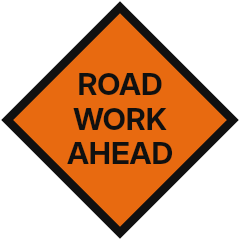
23. Beyond this sign, cones and temporary signs lead traffic along a path that does not agree with the lines painted on the pavement. Which one must the driver follow?
Show answer
Answer C: The temporary arrangement, because it replaces the permanent layout while the work lasts
Temporary traffic control set up for the work takes precedence over the permanent signs and markings, which no longer describe how the road is being used.
-
24. You are driving on the through road of a T-intersection and want to turn left into the side road. Oncoming traffic is approaching on the through road. What must you do?
Show answer
Answer C: Yield to the oncoming traffic before you turn
The vehicle waiting in the stem of the T yields to both of you, but you still owe the right of way to oncoming through traffic before turning across it.
-
25. How should a long trip be broken up to keep the driver alert?
Show answer
Answer D: Stop for a break every couple of hours and share out the driving
Regular breaks and a change of driver are the only reliable answers to fatigue; caffeine only postpones it.