
District of Columbia DC DMV Permit Practice Test 39
- Questions25
- Correct to pass20
- Passing score80%
- Minimum age16 years
-
1. May you use a relative's accessible parking placard to park in a marked accessible space?
Show answer
Answer D: No, only when the placard holder is being transported in the vehicle
A placard belongs to the person, not to the car, so it is valid only when that person is being transported; using it otherwise takes a space from someone who needs it.
-
2. A yellow diamond shows a car with wavy lines behind its rear tires. What is the warning?
Show answer
Answer D: The surface loses grip badly when it is wet
The slippery when wet sign marks a stretch where traction falls off sharply in rain, so speed and braking must be reduced well in advance.
-
3. What is the minimum age to obtain a DC DMV learner permit?
Show answer
Answer C: 16
An applicant must be at least 16 years old to obtain a learner permit in the District of Columbia.
-
4. What fine does DC set for exceeding the speed limit by up to 10 mph?
Show answer
Answer D: 50 dollars
The lowest DC speeding band, up to 10 mph over the limit, carries a 50 dollar fine.
-
5. An overhead lane-use control signal shows a steady red X above the lane you are traveling in. What does it require?
Show answer
Answer D: Leave that lane, because it is closed to you
A steady red X means road users are not permitted to use the lane beneath it, so you must move into a lane that is open.
-
6. The light ahead is green but traffic beyond the intersection is backed up. What should you do?
Show answer
Answer B: Wait behind the intersection until there is room to clear it completely
You may not enter an intersection unless you can get completely through it, because stopping inside blocks cross traffic when the signal changes.
-
7. You are traveling beside another vehicle on a multilane highway at nearly the same speed. Why is this a poor position?
Show answer
Answer B: You may be sitting in that driver's blind spot with nowhere to go if they move over
Driving alongside removes your side escape route and often puts you where the other driver cannot see you. Speed up or drop back to open space beside you.
-
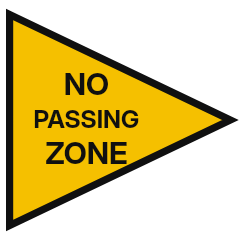
8. A driver is thinking about overtaking a slower vehicle and sees this sign a short distance ahead. What does it mean for that pass?
Show answer
Answer B: The pass must be finished before the restricted section begins
The sign marks the start of a section where passing is prohibited, so a driver may not be on the left side of the road beyond it; any pass has to be completed before that point or not started at all.
-
9. An overhead lane-use control signal shows a steady red X above your lane. What does it mean?
Show answer
Answer B: You may not use that lane and must move out of it
A steady red X means the lane below it is closed to you, while a steady yellow X is the warning to prepare to vacate the lane and a downward green arrow means the lane is open.
-
10. Permanent signs must be retroreflective or lighted so that
Show answer
Answer A: they show the same shape and color at night as by day
Retroreflective sheeting throws headlight light back to the driver, so a sign keeps its daytime shape and color after dark.
-
11. You find that the road surface has turned to sheet ice. What speed is appropriate?
Show answer
Answer A: A crawl, slow enough that you could stop without braking hard
Ice can cut grip to a fraction of normal, so stopping takes many times the usual distance and only a crawl leaves any margin.
-
12. You are following closely behind a vehicle you intend to pass on a two-lane road. What should you do first?
Show answer
Answer D: Drop back to give yourself room to build speed before you pull out
From close behind you cannot see far enough ahead and you have no room to gather speed, so the pass takes longer and starts blind.
-
13. What does DC require of a driver approaching a stationary authorized emergency vehicle?
Show answer
Answer B: Yield the right of way and proceed with due caution around it
DC regulations create a separate 100 dollar infraction for failing to yield the right of way and proceed with due caution around a stationary authorized emergency vehicle.
-
14. What is the correct relationship between air bags and seat belts?
Show answer
Answer B: Air bags are designed to work together with seat belts, not instead of them
An air bag is a supplemental restraint that cushions one impact, while the belt keeps you in position so the bag can work and protects you in rollovers and secondary impacts.
-
15. A train has just cleared a crossing that carries two sets of tracks. What should you do?
Show answer
Answer B: Wait and look both ways for a second train
A passing train hides a second train on the other track, so wait until the signals stop and you can see that both tracks are clear.
-
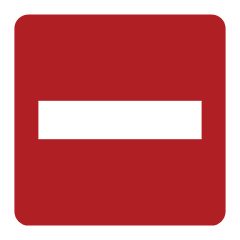
16. A driver hunting for an on-ramp meets this sign at the mouth of the pavement ahead. What is the correct action?
Show answer
Answer C: Keep out of that roadway and look for the proper approach elsewhere
The restriction is absolute and does not depend on how much traffic is present, so the driver has to reach the highway by an approach built for entering vehicles.
-
17. What insurance must be shown to register a vehicle in the District of Columbia?
Show answer
Answer B: Proof of valid DC insurance
All vehicles registered in the District must carry proof of valid DC insurance, which must be presented at registration.
-
18. What minimum age does the DC provisional license certification require the applicant to confirm?
Show answer
Answer C: 16 years and 6 months
The DC certification form has the applicant confirm being at least 16 years and 6 months old, six months after the earliest permit age.
-
19. A vehicle is sitting in your blind spot and you need to change into that lane. What should you do?
Show answer
Answer B: Adjust your speed to open a clear gap, then check again and move over
Changing your speed either drops the other vehicle behind you or lets it move ahead, which turns the blind spot back into open space.
-
20. How should you position your vehicle for a right turn from a two-way street?
Show answer
Answer B: As close as practical to the right curb or edge, then turn into the nearest right lane
Right turns are made from the lane nearest the right edge into the nearest available lane, which keeps the turn tight and prevents a wide sweep into other traffic.
-
21. What is the main function of the guide sign series?
Show answer
Answer D: To identify routes and lead road users to their destinations
Guide signs identify routes, name destinations and give distances, so drivers can navigate without stopping to consult a map.
-
22. How many points does DC assess for leaving the scene of a collision in which nobody was injured?
Show answer
Answer C: 8 points
Leaving the scene of a collision with no personal injury carries 8 points; if a person is injured the offense is a 12-point automatic revocation.
-
23. How far in advance must a DC road skills test appointment be cancelled to avoid a cancellation fee?
Show answer
Answer A: At least 48 hours before the appointment
DC DMV charges a cancellation fee unless the applicant cancels at least 48 hours before the road test appointment.
-
24. Why are eating, drinking and personal grooming risky behind the wheel?
Show answer
Answer B: They occupy hands, eyes and attention that driving requires
Each of these tasks takes a hand off the controls and attention off the road, and a spill or a dropped item can pull the driver's eyes away entirely.
-
25. The curb ahead is signed as a bus stop. May you wait there with your vehicle?
Show answer
Answer C: No, the space must stay clear for buses
A bus stop must stay open so that a bus can reach the curb and let passengers on and off safely, so no other vehicle may occupy it.