
District of Columbia DC DMV Motorcycle Practice Test 31
- Questions25
- Correct to pass20
- Passing score80%
- Minimum age16 years
-
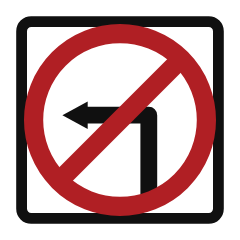
1. No plaque stating days or hours accompanies this sign at the intersection. When does the restriction apply?
Show answer
Answer D: At all times, since nothing limits it to particular periods
A regulatory restriction runs continuously unless a supplemental plaque states the days or hours during which it applies.
-
2. Visibility drops suddenly and you decide to leave the highway. What is the safest way to do it?
Show answer
Answer A: Take the next exit or a wide pull off, well clear of the traffic lanes
Get right off the traveled way, and off the shoulder too if you can, because vehicles in poor visibility often drift onto the shoulder.
-
3. After an hour on a hot highway your tire pressure reads higher than it did in the morning. What should you do?
Show answer
Answer D: Nothing, because pressure rises when tires heat up
Air expands as the tire warms, so a hot reading is normally above the cold setting. Bleeding air off would leave the tire underinflated once it cooled.
-
4. For how long must a DC license holder enrol in the Ignition Interlock System Program after a first covered offense?
Show answer
Answer C: 6 months
A first covered offense requires 6 months in the DC Ignition Interlock System Program, and the license stays suspended until the person enrols.
-
5. You are passing a large truck on an open highway in a strong crosswind. What should you expect?
Show answer
Answer A: A push toward the truck, then a push the other way as you clear it
The truck shelters you as you go by and then releases you into the full gust, so the load on the steering changes twice during the pass.
-
6. Fog thickens until you can barely make out the vehicle ahead. What is the safest action?
Show answer
Answer A: Slow right down and, if needed, leave the road at a safe place
In heavy fog the only safe speed may be very low, and if it drops below what the road allows, the answer is to pull well clear of the traffic lanes.
-
7. An ambulance with lights and siren is coming toward you on an undivided two-lane road. What must you do?
Show answer
Answer A: Pull to the right edge and stop until it passes
On an undivided road, drivers in both directions clear the way, pulling to the right edge and stopping.
-
8. Some crosswalks are marked with two transverse lines and others with a row of wide bars laid along the direction of travel. Why is the second pattern used?
Show answer
Answer B: It is far easier for an approaching driver to see
Longitudinal bar patterns are used where extra visibility is wanted, such as an uncontrolled crossing or one near a school, because they show up much better from a car.
-
9. You are driving through a neighborhood where several children are riding bicycles. What should you do?
Show answer
Answer C: Slow down and expect sudden, unpredictable moves
Young riders lack the judgment and the mirror habits of adults and may swerve or cross without looking, so lower speed is your only reliable margin.
-
10. How should a group plan its rest stops on a long day?
Show answer
Answer A: Around the rider who tires first, with breaks before anyone is worn out
Fatigue destroys judgment long before a rider admits to it, so the break schedule follows the least rested rider rather than the strongest one.
-
11. What does it mean to ride the clutch?
Show answer
Answer C: Holding the lever part way in while riding, which wears the clutch plates
Cruising with the clutch partly disengaged makes the plates slip against each other, which wears them out and removes engine braking.
-
12. In which crash must the police always be notified?
Show answer
Answer D: Any crash in which somebody has been injured or killed, whatever the damage
Injury or death always makes a crash reportable, whatever the amount of vehicle damage or the opinions of the drivers.
-
13. What does the T-CLOCS pre-ride inspection routine cover?
Show answer
Answer B: Tires and wheels, controls, lights, fluids, chassis and stands
T-CLOCS is a memory aid for a walk around check of tires and wheels, controls, lights and electrics, oil and other fluids, chassis, and side and center stands.
-
14. You are driving on the through road of a T-intersection and want to turn left into the side road. Oncoming traffic is approaching on the through road. What must you do?
Show answer
Answer C: Yield to the oncoming traffic before you turn
The vehicle waiting in the stem of the T yields to both of you, but you still owe the right of way to oncoming through traffic before turning across it.
-
15. In a normal signal cycle, what comes after a steady red indication?
Show answer
Answer A: A green indication that starts the next movement
Yellow is a warning that a movement is ending, so it never precedes a green; a red is followed by a green or a green arrow.
-
16. How does a NO OUTLET sign differ from a DEAD END sign?
Show answer
Answer B: It warns that a whole group of streets has no way out
No Outlet is posted where the road leads into a network of streets from which there is no through route, while Dead End refers to the single street itself.
-
17. What is the PRIME position on a fuel supply valve used for?
Show answer
Answer D: To let fuel flow into the carburetor after the machine has stood unused
PRIME bypasses the normal vacuum control and lets fuel refill an empty carburetor, which helps a machine start after sitting for a long time.
-
18. The temperature gauge climbs toward the red while you sit in slow moving traffic. What should you do?
Show answer
Answer A: Get out of the traffic as soon as it is safe and let the engine cool
A stationary motorcycle gets almost no airflow through the engine or radiator, so the cure is to stop creeping along in traffic and let it cool.
-
19. What does research say about the effect of a full coverage helmet on a rider's ability to see and hear traffic?
Show answer
Answer B: It leaves the view and the useful hearing a rider needs largely intact
Certified helmets leave far more peripheral vision than a rider needs to check traffic, and riders wearing them still hear the sounds that matter.
-
20. Compared with dry pavement, how much room does a vehicle need to stop on packed snow?
Show answer
Answer D: Several times as much
Grip on packed snow is a fraction of that on dry pavement, so stopping distance grows several times over. Antilock brakes help you steer, not stop shorter.
-
21. You are following a tractor-trailer so closely that its rear doors fill your windshield. What is the main problem?
Show answer
Answer D: You cannot see the road ahead and the truck driver cannot see you
A truck has a deep blind spot directly behind it, and tailgating also hides everything in front of the truck from you. Drop back so you can see and be seen.
-
22. You are circulating in the inner lane of a two-lane roundabout, your exit is next, and a vehicle is beside you in the outer lane. What should you do?
Show answer
Answer C: Keep circulating around the island and take that same exit on your next time around
You may not cut across a vehicle in the outer lane; if you cannot exit safely, continue around the circle and try again.
-
23. How can you keep space at the sides of your vehicle in heavy traffic?
Show answer
Answer D: Drive in the gaps between the other vehicles rather than beside them
Travelling in the open spaces rather than alongside others keeps a way out open on at least one side.
-
24. Why is a U-turn on a one-way street a problem?
Show answer
Answer A: You would end up facing the wrong way against all the traffic
Every lane of a one-way street runs the same way, so turning around leaves you driving head-on against all of the traffic.
-
25. It is dusk and a jogger in dark clothing is running along the edge of the road. What should you do?
Show answer
Answer D: Slow down and scan the edges of the road
Dusk is the hardest light for spotting people, and dark clothing removes most of your warning, so lower speed and a careful scan of the roadsides are the answer.