
District of Columbia DC DMV Motorcycle Practice Test 49
- Questions25
- Correct to pass20
- Passing score80%
- Minimum age16 years
-
1. What is the recommended way to park a motorcycle at a curb?
Show answer
Answer C: At an angle, with the rear wheel touching the curb
Backing the rear wheel to the curb at an angle keeps the motorcycle clear of traffic and lets the rider ride out forward instead of backing into the lane.
-
2. How should a driver respond to this sign?
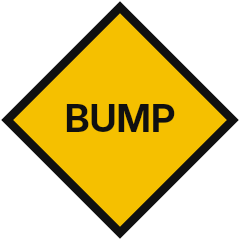
Show answer
Answer C: Slow down before reaching the rough spot and cross it at a steady, low speed
Losing speed before a sharp rise in the pavement keeps the vehicle settled, while braking or accelerating on top of it unsettles the suspension and costs grip.
-
3. A yellow lamp flashes above a warning sign at a sharp curve. What does it ask of a driver?
Show answer
Answer D: Slow down and pass the point with extra care
A warning beacon draws attention to the sign it is mounted with, and the message of the sign is what the driver must act on.
-
4. You are stopped in a line of traffic on a steep uphill grade. What should you do about the gap to the vehicle ahead?
Show answer
Answer B: Leave more room than usual, because vehicles can roll back as they pull away
A vehicle ahead can roll back a foot or more as its driver releases the brake, and a motorcycle stopped tight behind it has nowhere to go.
-
5. On a street with parking along the curb, the shared lane marking is painted well out from the curb face. What does that placement tell a bicyclist?
Show answer
Answer C: To ride clear of the doors of parked cars
The marking is set at least eleven feet from the curb where parking is allowed so that riders are guided outside the reach of an opening door.
-
6. Where is passing prohibited even when no line is visible?
Show answer
Answer D: On a curve or near the crest of a hill, at intersections and at railroad crossings
Passing is prohibited wherever your view of oncoming traffic is blocked or where vehicles may cross your path, which includes hills, curves, intersections and rail crossings.
-
7. What is the best way to keep your phone from distracting you on a trip?
Show answer
Answer D: Silence it and stow it before you start
A phone you cannot hear and cannot reach cannot tempt you, which is far more reliable than deciding case by case while you drive.
-
8. How can you tell a tire has reached its wear limit without measuring it?
Show answer
Answer C: The wear bars across the grooves become level with the tread
Molded bars sit at the bottom of the grooves. Once the surrounding tread has worn down to them, the tire has reached the end of its safe life.
-
9. An emergency vehicle is stopped on the shoulder ahead with its lights flashing. What does the move over principle require?
Show answer
Answer D: Change lanes away from it, or slow down if you cannot
Move over laws ask you to give responders an empty lane, and where traffic or a two-lane road makes that impossible, you slow down instead.
-
10. Which out-of-jurisdiction training does the DC motorcycle manual say can replace the DC DMV motorcycle demonstration skills test?
Show answer
Answer C: A motorcycle demonstration course certificate approved by Maryland or Virginia
The DC DMV motorcycle manual accepts a motorcycle demonstration course certificate of completion approved by Maryland or Virginia in place of the DC skills test.
-
11. What happens to a DC driver license when the holder reaches 10 or 11 points?
Show answer
Answer A: It is suspended and driving privileges are lost for 90 days
A DC driver who accumulates 10 or 11 points loses driving privileges for 90 days.
-
12. Which set of qualities should eye protection for riding have?
Show answer
Answer A: Shatter resistant, free of scratches, and sealed against the wind
Riding eye protection has to survive an impact, let you see clearly and keep the air out, which is why plastic face shields and goggles are used instead of ordinary glasses.
-
13. Which clue tells you that a parked vehicle is about to pull into traffic?
Show answer
Answer D: Exhaust smoke, brake lights, front wheels turned out or a driver in the seat
A running engine, lit brake lights, turned wheels or a person behind the wheel all mean the vehicle may move. Slow down and give it room.
-
14. Smoke and flames appear from the engine compartment after you stop. What should you do?
Show answer
Answer A: Get everyone well away from the vehicle first, and then call the fire service
A vehicle fire can spread within seconds, so people come out first and firefighting is left to the fire service.
-
15. Besides school signing, which warning signs may also use a fluorescent yellow-green background?
Show answer
Answer C: Pedestrian and bicycle warning signs
Pedestrian crossing, bicycle and playground warning signs may use either the standard yellow or the fluorescent yellow-green background, which draws extra attention where people outside vehicles are present.
-
16. Studies of damaged helmets show that the most frequently struck area is which part?
Show answer
Answer C: The chin and jaw area, which an open face helmet leaves uncovered
The chin and face area takes a large share of helmet impacts, which is the main safety argument for a full face helmet over an open face one.
-
17. Apart from giving you room to stop, what else does a longer following gap do for you?
Show answer
Answer D: It widens your view of the road and the traffic ahead
Sitting further back lets you see past and around the vehicle in front, so hazards reach your eyes seconds earlier.
-
18. A sign reads END SCHOOL ZONE. What does it tell a driver?
Show answer
Answer A: The regular limit for that road applies again
An end of restriction sign marks the downstream limit of a special zone, after which the ordinary speed limit for that road governs again.
-
19. What does a broken line indicate, whatever color it is painted?
Show answer
Answer C: That crossing it is permitted
A broken line always describes a permissive condition, and the color then tells the driver whether the traffic beyond it runs the same way or the opposite way.
-
20. Lights set into the pavement along both edges of a crosswalk start to flash yellow as you approach. What do they tell you?
Show answer
Answer D: Someone is crossing and has to be given way
In-roadway warning lights flash only when a pedestrian activates the crossing, so a flashing pattern means somebody is in or entering the crosswalk.
-
21. Why do experienced riders squeeze the clutch lever while starting the engine, even with the neutral light showing?
Show answer
Answer A: In case a gear is engaged, so the motorcycle cannot lurch forward
A neutral light can be wrong, and a disengaged clutch means the machine stays still even if the transmission is actually in gear.
-
22. You are riding a city street with embedded streetcar rails and it has just started to rain. What is the added risk?
Show answer
Answer D: Wet steel rails offer very little grip, and so does the pavement beside them
Steel rails give almost no traction when wet, so cross them upright at as close to a right angle as the lane allows, without braking or turning on the metal.
-
23. When should tire pressure be measured?
Show answer
Answer B: Before riding, while the tires are still cold
Riding heats the air inside a tire and raises the reading, so pressure is set cold to match the figure the manufacturer specifies.
-
24. Red pavement markings are used on a roadway to show that
Show answer
Answer A: it must not be entered from that direction
Red markings identify a roadway that is not to be entered or used, and they also mark the pavement of truck escape ramps.
-
25. What uninsured motorist property damage coverage must a DC policy include?
Show answer
Answer A: 5,000 dollars, subject to a 200 dollar deductible
DC requires 5,000 dollars of uninsured motorist property damage coverage, subject to a 200 dollar deductible.