
District of Columbia DC DMV Motorcycle Practice Test 1
Test 1 of 6. Pick an answer for each question to see if it is right and why; your score appears at the end. You need 20 correct answers to pass, the same ratio as the real District of Columbia test.
- Questions25
- Correct to pass20
- Passing score80%
- Minimum age16 years
-
1. What weight does DC law give to an image recorded by an automated traffic enforcement system?
Show answer
Answer D: It is prima facie evidence of the infraction and needs no authentication
DC law makes recorded images prima facie evidence of the infraction and allows them to be submitted without authentication.
-
2. A downpour has just started on a street with a visible dark strip down the middle of the lane. Where should you ride?
Show answer
Answer A: In the left or right portion of the lane, away from the greasy center strip
Dripped oil and grease build up in the center of the lane, and water floats that film to the top, so the tire tracks on either side offer better grip.
-
3. What uninsured motorist bodily injury coverage must a DC policy carry?
Show answer
Answer C: 25,000 dollars per person and 50,000 dollars per accident
DC requires uninsured motorist bodily injury coverage of 25,000 dollars per person and 50,000 dollars per accident, matching the liability minimums.
-
4. Which out-of-jurisdiction training does the DC motorcycle manual say can replace the DC DMV motorcycle demonstration skills test?
Show answer
Answer C: A motorcycle demonstration course certificate approved by Maryland or Virginia
The DC DMV motorcycle manual accepts a motorcycle demonstration course certificate of completion approved by Maryland or Virginia in place of the DC skills test.
-
5. Why is texting considered one of the most dangerous distractions?
Show answer
Answer B: It combines visual, manual and cognitive distraction at the same time
Reading or writing a message takes your eyes off the road, at least one hand off the controls and your attention off driving simultaneously.
-
6. You are waiting to enter a two-lane roundabout and traffic is circulating in both lanes. What must you do?
Show answer
Answer A: Yield to traffic in both circulating lanes before you enter
Every entry to a roundabout is a yield point, and at a two-lane roundabout that means giving way to vehicles in either circulating lane.
-
7. What must a DC driver do when an authorized emergency vehicle approaches using audible and visual signals?
Show answer
Answer C: Drive to the right-hand edge or curb, clear of any intersection, and stop until it passes
DC regulations require the driver to yield, drive parallel and as close as possible to the right-hand edge or curb, clear of any intersection, and stop until the emergency vehicle has passed.
-
8. How many points does DC assess for driving 11 to 15 mph above the posted speed limit?
Show answer
Answer D: 3 points
The DC point chart assigns 3 points to speeding of 11 to 15 mph over the limit, rising with each higher speed band.
-
9. You are approaching a blind right hand curve. Which starting lane position gives the best view through it?
Show answer
Answer C: The left portion of the lane, toward the outside of the curve
Starting at the outside of a curve opens up the line of sight through it, and the rider then moves toward the inside as the exit comes into view.
-
10. Why should riding clothing have no loose flapping parts?
Show answer
Answer B: Loose cloth can catch on the machine, and flapping tires the rider
Loose fabric can snag on the controls, the chain or a wheel, and the constant flapping and noise wear the rider out over a long ride.
-
11. What fee does DC DMV charge to add the motorcycle M endorsement online?
Show answer
Answer B: 20 dollars
The DC DMV motorcycle endorsement costs 20 dollars when added online after the certificate is verified.
-
12. What fine does DC set for exceeding the speed limit by 16 to 20 mph?
Show answer
Answer A: 150 dollars
Driving 16 to 20 mph over the limit in DC carries a 150 dollar fine, against 100 dollars for 11 to 15 mph over.
-
13. How does DC law treat a driver's refusal to submit to a chemical test at a later hearing or trial?
Show answer
Answer A: The refusal is admissible in evidence
DC law makes evidence of the refusal admissible in any civil or criminal proceeding arising from the conduct alleged before the arrest.
-
14. Heavy rain has left water standing on the highway. What is the main risk to a rider?
Show answer
Answer D: The tires can ride up on the water and lose contact with the road surface
At higher speeds a tire can no longer push standing water aside and starts to hydroplane, so the rider slows and eases off rather than braking or turning hard.
-
15. For how long is a DC driver license revoked after a third driving under the influence conviction within 15 years?
Show answer
Answer B: 3 years
A third DUI within 15 years costs the DC driver a three-year revocation, against six months for a first and one year for a second.
-
16. You are traveling beside a tractor-trailer and cannot see the truck driver's face in any of the truck's mirrors. What does that tell you?
Show answer
Answer A: The truck driver probably cannot see your vehicle
Large trucks have deep blind spots on all four sides, so if the driver's face is not visible in a mirror the driver has no view of you. Move ahead or drop back until you are out of that area.
-
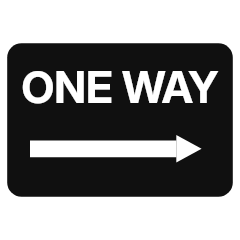
17. Where are signs of this kind placed at an intersection?
Show answer
Answer C: At the near right and far left corners, facing drivers on the intersecting street
They are installed at the corners of the intersecting street so that a driver about to turn in sees the restriction before committing to the turn.
-
18. How close may a DC driver follow fire apparatus responding to an alarm?
Show answer
Answer B: No closer than 500 feet
DC regulations make it an infraction to follow fire apparatus within 500 feet.
-
19. A sign on a long downgrade points to a runaway vehicle ramp. What is that ramp for?
Show answer
Answer C: Trucks that have lost braking ability on the grade
A runaway ramp is an escape lane of loose material that stops a heavy vehicle whose brakes have overheated or failed, so it must always be left clear.
-
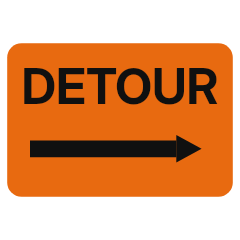
20. Which of these is true of the roadway a driver is being sent onto here?
Show answer
Answer D: Its own signs, signals and speed limits govern for the whole way around
The alternate route is an ordinary public road, so every control posted on it governs as usual; being sent that way grants no extra priority and no relief from the limits in force there.
-
21. What mandatory minimum jail term applies to a first DC impaired driving conviction when the alcohol concentration was 0.20 or higher?
Show answer
Answer B: 10 days
A first DC conviction with an alcohol concentration of 0.20 or more carries a mandatory minimum of 10 days, and the minimum rises further at 0.25 and 0.30.
-
22. Which mobile telephone use does DC law expressly exempt from the hands-free requirement?
Show answer
Answer A: An emergency call to 911 or 311, a hospital, an ambulance service, a fire department or a law enforcement agency
DC law exempts emergency use of a mobile telephone, including calls to 911 or 311, a hospital, an ambulance service provider, a fire department, a law enforcement agency or a first-aid squad.
-
23. How many points does DC assess for failing to yield to an emergency vehicle?
Show answer
Answer D: 6 points
The DC point chart assigns 6 points for failing to yield to an emergency vehicle, the same as reckless driving.
-
24. What is the most common cause of rear-end collisions?
Show answer
Answer C: Following too closely to stop in time
A driver who leaves too little space has no room to perceive, react and brake when the vehicle ahead slows, which is why space management prevents rear-end crashes.
-
25. You are about to pull out from a stop sign. Which scanning habit is correct?
Show answer
Answer A: Look to the left, then to the right, then to the left again before moving
Traffic from the left reaches you first, and a second look left catches anything that arrived while you were looking right.