
District of Columbia DC DMV Motorcycle Practice Test 38
- Questions25
- Correct to pass20
- Passing score80%
- Minimum age16 years
-
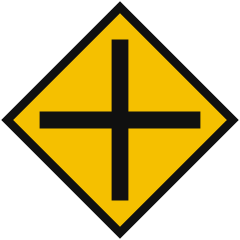
1. Does this sign settle who has the right-of-way at the intersection ahead?
Show answer
Answer D: No, it only gives notice of the intersection; the control there decides priority
A warning prepares the driver for what is coming but grants no priority, so whatever stop control, yield control, signal or right-of-way rule applies at the intersection is what decides.
-
2. You are passing a line of slow traffic in the lane beside you and you notice a gap in that line ahead. What should you expect?
Show answer
Answer A: A vehicle may pull out of that gap into your lane
A gap in a slow line is an invitation to any driver waiting to turn out of a side street or to change lanes, and they are looking at the gap rather than at you.
-
3. What is a designated driver?
Show answer
Answer A: Someone who agrees to drink nothing at all
A designated driver drinks no alcohol whatsoever, because any amount begins to affect judgment and the whole point is a sober driver.
-
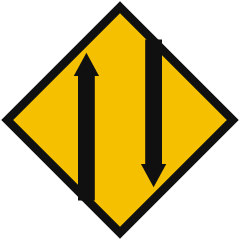
4. What is a driver being warned about here?
Show answer
Answer B: The pavement ahead carries vehicles traveling in the opposite direction
Beyond this point vehicles come the other way on the same pavement, which commonly happens where a one-way section or a separated stretch comes to an end.
-
5. What is the proper use of the horn?
Show answer
Answer C: To give a brief warning when another road user may not have seen you
The horn is a warning device meant to alert someone to your presence when a collision is possible, and using it in anger tends to escalate conflict rather than prevent crashes.
-
6. What does a sign reading Slower Traffic Keep Right require?
Show answer
Answer C: Traffic moving slower than the general flow must use the right-hand lane
The sign applies to any vehicle traveling below the speed of the traffic around it, which must keep right so faster vehicles can use the lanes to the left.
-
7. You are on an entrance ramp joining a busy freeway. What should you do with your speed in the acceleration lane?
Show answer
Answer D: Build it up to about the speed of the traffic you are joining
Merging works when your speed matches the traffic stream, because a large speed difference forces the drivers already on the freeway to brake or swerve.
-
8. You have turned onto a street and see parked cars facing you and headlights coming toward you. What has probably happened?
Show answer
Answer C: You have turned the wrong way onto a one-way street
Vehicles parked facing you and headlights approaching in your lane are the classic signs of driving against the flow on a one-way street.
-
9. Below a speed limit sign is a smaller panel with white numbers on a black background and the word NIGHT. What does it show?
Show answer
Answer D: The limit that applies after dark
A night speed limit panel sets a separate legal maximum for the hours of darkness, and its reversed colors mark it as the night figure.
-
10. What should you confirm about your saddlebags before riding away?
Show answer
Answer A: That both are latched shut and neither is overloaded
An unlatched or overstuffed bag can swing open or sag into the rear wheel or the exhaust, either of which can wreck the machine's handling at once.
-
11. You are approaching a driveway where a car waits to pull out and the driver is looking your way. What should you assume?
Show answer
Answer D: The driver may not have seen you, so cover the brakes and be ready to slow
Looking in your direction is not proof that a driver has registered a motorcycle, so cover the brakes and be ready to slow until the car is clearly staying put.
-
12. The road ahead is broken up with potholes and rough patches. What should you do?
Show answer
Answer C: Slow down, since a hole hit at speed can wreck a tire or wheel
A lower speed cuts the impact on tires, wheels and suspension and gives you time to choose a line through the rough surface.
-
13. Which of these would appear as a symbol on a blue general service sign?
Show answer
Answer A: A hospital
General service signs cover facilities such as hospitals, fuel, food, lodging, camping, telephones and rest areas, all shown in white on blue.
-
14. When should gear changes for a turn be completed?
Show answer
Answer A: Before entering the turn, so the machine stays settled through it
A clumsy shift while leaned over can jerk the rear wheel and break traction, so the right gear should be selected before the lean begins.
-
15. You are approaching a sharp curve. When should you reduce your speed?
Show answer
Answer D: Before you enter the curve, so you can accelerate gently through it
Braking hard inside a curve uses up the traction that is already being demanded for cornering, so the slowing must be finished before you enter.
-
16. How much time does DC DMV allow for the motorcycle knowledge test?
Show answer
Answer B: 60 minutes
DC DMV allows 60 minutes for the motorcycle knowledge test, the same limit as the non-commercial test.
-
17. How many points does a reckless driving conviction add to a DC driving record?
Show answer
Answer D: 6 points
Reckless driving carries 6 points on the DC point chart, half the total that triggers automatic revocation.
-
18. You are about to carry a passenger for the first time. Where should you begin?
Show answer
Answer C: In a quiet area away from traffic, at low speed
A passenger changes balance, braking and steering feel, and those differences are best learned somewhere there is nothing else to deal with.
-
19. When should most of your braking for a turn be finished?
Show answer
Answer B: Before you begin to turn the wheel
Slow to the right speed before the turn begins; braking hard while turning uses up the grip the tires need for steering.
-
20. Why is an underinflated tire especially risky on a long drive in hot weather?
Show answer
Answer C: It flexes more, builds up heat and can fail at speed
A soft tire flexes on every rotation, and that flexing makes heat that the hot road and high speed add to until the tire can come apart.
-
21. Traffic safety experts describe three kinds of driver distraction. Which set is correct?
Show answer
Answer A: Visual, manual and cognitive
Distraction takes the eyes off the road, the hands off the controls or the mind off driving, and many activities do more than one of those at once.
-
22. A rider chooses an open face helmet. What does that choice make necessary?
Show answer
Answer A: Separate goggles or a face shield, because the face is uncovered
An open face helmet gives no eye or face protection, so the rider must add goggles or a face shield that will not shatter and that seals against the wind.
-
23. You feel dizzy, weak and clammy after an hour of riding in high heat. What should you do?
Show answer
Answer B: Stop in the shade, drink water and cool down before riding further
Those are early signs of heat illness and they get worse with continued exertion, so get out of the sun, rehydrate and cool off before you ride on.
-
24. A rider needs to stop quickly while leaned over in a curve. What is the best technique?
Show answer
Answer D: Bring the motorcycle upright where possible, then brake firmly with both brakes
An upright tire has more traction available for braking, so lean angle should be reduced as brake pressure is increased.
-
25. Which clothing color is most likely to get a rider noticed in daylight?
Show answer
Answer B: Bright orange, yellow or green, which contrast with backgrounds
High visibility colors stand out against road, foliage and vehicles, which helps drivers pick a motorcycle out of a busy background during the day.