
District of Columbia DC DMV Motorcycle Practice Test 39
- Questions25
- Correct to pass20
- Passing score80%
- Minimum age16 years
-
1. You have had to leave the pavement onto a loose gravel shoulder and now need to stop. How should you brake?
Show answer
Answer D: Use both brakes gently and evenly, expecting a much longer stopping distance
Loose gravel cuts available traction sharply, so apply both brakes lightly and smoothly and allow far more room than you would need on pavement.
-
2. Where do the greatest number of collisions involving motorcycles occur?
Show answer
Answer D: At intersections
Intersections concentrate crossing and turning paths, and the most common single event is a car turning left across the path of an oncoming motorcycle.
-
3. The engine begins to lose power, makes a loud noise and starts to seize. What should the rider do?
Show answer
Answer C: Pull in the clutch at once and coast off the road to a safe place
A seizing engine can lock the rear wheel, and pulling in the clutch separates it from the wheel so the motorcycle keeps rolling under control.
-
4. A rider adjusts the mirrors and finds each one mostly filled with a view of an elbow. What should be done?
Show answer
Answer D: Readjust them outward so that more of the lane behind becomes visible
Mirrors are useful only for the road behind, and half a mirror filled with the rider is half of an already limited view thrown away.
-
5. You arrive at a four-way stop after two other vehicles have already stopped there. When is it your turn?
Show answer
Answer A: After both of the earlier vehicles have gone
Vehicles clear a four-way stop in the order they arrived, so the third driver to stop is the third to go.
-
6. Where is ice most likely to form first on a cold day?
Show answer
Answer B: In shaded areas and on bridges and overpasses
Shaded spots stay cold longer and bridges and overpasses lose heat from below as well as above, so ice appears there before it appears elsewhere.
-
7. Why is an inexperienced rider a poor choice to lead a group?
Show answer
Answer C: The leader picks the pace, the gaps and the hazards for everyone behind
Every decision the leader makes is imposed on the riders behind, so leading demands more traffic judgment than any other position in the group.
-
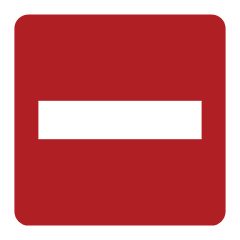
8. A driver hunting for an on-ramp meets this sign at the mouth of the pavement ahead. What is the correct action?
Show answer
Answer C: Keep out of that roadway and look for the proper approach elsewhere
The restriction is absolute and does not depend on how much traffic is present, so the driver has to reach the highway by an approach built for entering vehicles.
-
9. A bicyclist stops at a four-way stop just before you do. Who goes first?
Show answer
Answer B: The bicyclist, who reached the intersection and stopped there before you did
A bicyclist on the roadway follows the same right of way rules as a driver, so arrival order decides the turn.
-
10. What is the function of a regulatory sign?
Show answer
Answer A: To inform road users of traffic laws or regulations that apply at that location
Regulatory signs state requirements that carry the force of law where they are posted, so disregarding one is a violation rather than a lapse of judgment.
-
11. The red lights on a stopped school bus go out and the bus begins to move away. What should you do?
Show answer
Answer B: Move off slowly and keep watching for children near the road
Children who have just left the bus may still be near the roadway or crossing behind it, so pull away gently and keep looking for them.
-
12. Which is an early warning that fatigue is affecting your riding?
Show answer
Answer D: You miss turns and signs and have to think about routine actions
Fatigue shows up first as slower thinking and missed information, so treat lapses in attention as a signal to stop and rest.
-
13. Why is a shoulder check especially important on a road with motorcycles and bicycles?
Show answer
Answer D: A narrow vehicle can disappear completely in the blind spot
A motorcycle or a bicycle is small enough to be hidden entirely by a door pillar or by the blind spot the mirrors do not cover.
-
14. What is the first riding effect of becoming dehydrated on a hot day?
Show answer
Answer D: Concentration and judgment fade before the rider feels very thirsty
Thirst lags behind fluid loss, so a rider can lose concentration and coordination before feeling thirsty. Drink regularly on hot rides rather than waiting.
-
15. How does the crown of a road affect a turn made on it?
Show answer
Answer C: Turning toward the low side leaves less ground clearance for leaning
Leaning down the slope of the crown adds the slope to the lean angle, so the footrests and other parts reach the pavement sooner than they otherwise would.
-
16. A person in a wheelchair is traveling in the roadway because the sidewalk is blocked by construction. What should you do?
Show answer
Answer B: Pass slowly with plenty of room, or wait
A blocked sidewalk leaves the person no choice but the road, and a chair cannot move aside quickly, so pass wide and slow or wait for room.
-
17. As a center two-way left-turn lane reaches an intersection, the markings change into a single left-turn lane. What does that mean for you?
Show answer
Answer D: From that point it serves one direction only, so use it just to turn left
Where the shared lane becomes a marked turn bay it belongs to one direction of travel, and only vehicles making that left turn may occupy it.
-
18. Your loaded vehicle weighs more than the figure shown on a posted weight limit sign. What must you do?
Show answer
Answer D: Find another route, because crossing is not permitted
A posted weight limit is a legal maximum, not advice, so an overweight vehicle has to take a different route.
-
19. You are about to pass a long tractor-trailer on a two-lane road. What should you expect?
Show answer
Answer B: You will need more clear road, since the vehicle is much longer
A tractor-trailer can be 70 feet long, so passing it takes more distance and more time than passing a car at the same speed difference.
-
20. The front tire suddenly loses air while you are riding. What should you do?
Show answer
Answer D: Hold the bars firmly, ease off the throttle and slow using the rear brake
A deflating front tire makes the steering feel heavy, so the rider keeps a straight line, avoids the affected wheel when braking and eases off the road.
-
21. You feel fine twenty minutes after your last drink. Why is that a poor guide to driving?
Show answer
Answer B: Your blood alcohol level can still be rising
Alcohol keeps being absorbed for some time after the last drink, so a driver who feels able at the door can be more impaired a few miles down the road.
-
22. You are approaching the entry of a modern roundabout. Who must you yield to?
Show answer
Answer C: Traffic already circulating in the roundabout, which approaches from your left
Traffic in a United States roundabout circulates counterclockwise, so drivers entering must look left and yield to vehicles already in the circulating roadway.
-
23. What is the right speed for a normal right turn at a city corner?
Show answer
Answer C: Slow enough to hold your lane and stop for a pedestrian
A city right turn is tight and crosses a crosswalk, so the correct speed is one that keeps you inside your lane and still allows a stop.
-
24. A strong wind is blowing across an open stretch of road. Besides the gusts, what else should you watch for?
Show answer
Answer A: Branches, dust and loose objects blown into your path
High wind strips branches, litter and dust onto the roadway and can push other vehicles out of their lane, so scan much further ahead than usual.
-
25. Why is texting considered one of the most dangerous distractions?
Show answer
Answer B: It combines visual, manual and cognitive distraction at the same time
Reading or writing a message takes your eyes off the road, at least one hand off the controls and your attention off driving simultaneously.