
District of Columbia DC DMV Permit Practice Test 3
Test 3 of 10. Pick an answer for each question to see if it is right and why; your score appears at the end. You need 20 correct answers to pass, the same ratio as the real District of Columbia test.
- Questions25
- Correct to pass20
- Passing score80%
- Minimum age16 years
-
1. What fine does DC set for exceeding the speed limit by 16 to 20 mph?
Show answer
Answer A: 150 dollars
Driving 16 to 20 mph over the limit in DC carries a 150 dollar fine, against 100 dollars for 11 to 15 mph over.
-
2. A police officer in the intersection raises a hand toward you although your signal is green. What should you do?
Show answer
Answer B: Stop and wait for the officer to wave you on
An officer directing traffic overrides signals and signs, and drivers must follow the officer even when the light says otherwise.
-
3. Why is wearing headphones over both ears a problem while driving?
Show answer
Answer D: You may not hear horns, sirens or other warning sounds
Hearing is part of your awareness of traffic. Covering both ears blocks emergency sirens, horns and the sound of an approaching vehicle you cannot yet see.
-
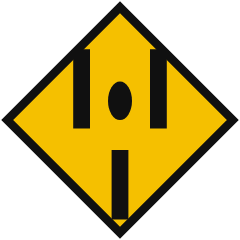
4. What must a driver be ready for beyond this sign?
Show answer
Answer C: Vehicles approaching from the opposite direction in the next lane over
The separation between the two directions runs out, so from that point oncoming vehicles share the same pavement and the driver has to keep right.
-
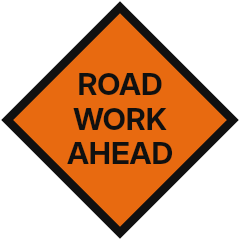
5. Beyond this sign, cones and temporary signs lead traffic along a path that does not agree with the lines painted on the pavement. Which one must the driver follow?
Show answer
Answer C: The temporary arrangement, because it replaces the permanent layout while the work lasts
Temporary traffic control set up for the work takes precedence over the permanent signs and markings, which no longer describe how the road is being used.
-
6. Which surfaces usually offer less grip than the pavement around them when wet?
Show answer
Answer B: Painted markings, metal plates and bridge decks
Paint, steel and bridge decks all shed grip when wet or cold, so brake before you reach them rather than on top of them.
-
7. For how long must a DC license holder enrol in the Ignition Interlock System Program after a first covered offense?
Show answer
Answer C: 6 months
A first covered offense requires 6 months in the DC Ignition Interlock System Program, and the license stays suspended until the person enrols.
-
8. What does DC law say about an open container of alcohol inside a vehicle parked on a public street?
Show answer
Answer B: It is prohibited, and the offense can carry up to 60 days of imprisonment
DC law bans drinking or possessing an open container of alcohol in or upon a vehicle in or upon any street, alley, park or parking area, with a penalty of up to 60 days.
-
9. On a regulatory sign, what does a red circle with a diagonal slash drawn over a symbol mean?
Show answer
Answer D: The movement or action shown by the symbol is prohibited
A red circle with a diagonal slash is the standard way of showing that the movement pictured inside it, such as a U-turn or a right turn, is not allowed.
-
10. The electric windows will not work as your vehicle sinks in water. What is the best option?
Show answer
Answer C: Break a side window with a hard, pointed object and climb out through it
Side windows are tempered glass and can be broken, while the laminated windshield cannot, and water pressure holds the doors shut.
-
11. You are driving in the left lane at the posted speed limit and a line of vehicles has built up behind you. What should you do?
Show answer
Answer D: Move into a lane on your right when it is safe and let the traffic behind go by
Most states require traffic moving slower than the flow to keep right and reserve the left lane for passing, so a driver holding up a line of vehicles should move right when it is safe rather than block the lane.
-
12. You are turning right onto a one-way street. Which lane of that street should you enter?
Show answer
Answer C: The lane closest to the right curb
Even though every lane on a one-way street runs your way, a right turn must end in the lane nearest the right curb; you may change lanes afterwards when it is safe.
-
13. When do the DC provisional license hour restrictions not apply?
Show answer
Answer B: When driving to or from work, school events, religious or athletic activities, or when accompanied by a licensed driver aged 21 or older
The hour limits are waived for work, school, religious and athletic travel, and when a licensed driver aged 21 or older is in the vehicle.
-
14. How many points does DC assess for leaving the scene of a collision in which nobody was injured?
Show answer
Answer C: 8 points
Leaving the scene of a collision with no personal injury carries 8 points; if a person is injured the offense is a 12-point automatic revocation.
-
15. How can a first-time DC handheld phone offender have the fine suspended?
Show answer
Answer B: By showing proof that a hands-free accessory has been bought before the fine is imposed
DC suspends the fine for a first-time violator who provides proof of acquiring a hands-free accessory after the violation but before the fine is imposed; the relief does not extend to texting.
-
16. Which vehicles may a DC full license with conditions holder under 18 drive?
Show answer
Answer A: Passenger cars and motorized bicycles, for personal use
The DC conditions limit a holder under 18 to driving passenger cars or motorized bicycles for personal use.
-
17. What alcohol concentration makes a driver of a non-commercial vehicle intoxicated under DC law?
Show answer
Answer C: 0.08
DC law sets 0.08 grams per 100 milliliters of blood, or per 210 liters of breath, for non-commercial drivers.
-
18. How close may a DC driver follow fire apparatus responding to an alarm?
Show answer
Answer B: No closer than 500 feet
DC regulations make it an infraction to follow fire apparatus within 500 feet.
-
19. Cones and drums mark a shifted lane through a work zone. What should you do?
Show answer
Answer A: Follow the path that they mark and stay inside it
Channelizing devices define the temporary travel path, and the space on the other side of them belongs to the workers.
-
20. On a rural two-lane road you pass small blue signs, each naming one business with an arrow and a distance. What are they?
Show answer
Answer D: Tourist-oriented directional signs for traveler businesses
Tourist-oriented directional signs carry a white legend on blue and are used on rural conventional roads to guide travelers to eligible businesses.
-
21. You are at a red light where right turns on red are allowed, you cannot see clearly, and the driver behind sounds the horn. What should you do?
Show answer
Answer C: Stay stopped until you can see that the turn is safe
Turning right on red is permitted, never required, so you wait until you can see that the way is clear no matter what the driver behind does.
-
22. A broken white line separates your lane from the lane on your right. What does it permit?
Show answer
Answer C: Changing lanes when it is safe to do so
A normal broken white line marks a boundary between lanes traveling the same way that road users may cross when it is safe.
-
23. How far in advance must a DC road skills test appointment be cancelled to avoid a cancellation fee?
Show answer
Answer A: At least 48 hours before the appointment
DC DMV charges a cancellation fee unless the applicant cancels at least 48 hours before the road test appointment.
-
24. You feel drowsy, so you open a window and turn the radio up. What does that achieve?
Show answer
Answer B: Very little, because the drowsiness comes back
Cold air and loud music are not sleep, so the alerting effect lasts a minute or two and the driver is soon just as sleepy and closer to a lapse.
-
25. How long do points remain on a DC driving record?
Show answer
Answer A: Two years
DC DMV keeps assessed points on the driving record for two years.