
District of Columbia DC DMV Permit Practice Test 6
Test 6 of 10. Pick an answer for each question to see if it is right and why; your score appears at the end. You need 20 correct answers to pass, the same ratio as the real District of Columbia test.
- Questions25
- Correct to pass20
- Passing score80%
- Minimum age16 years
-
1. How long should a glance at a mirror or an instrument take?
Show answer
Answer A: A brief glance of about a second, returning your eyes to the road at once
Checks should be quick flicks of the eyes. At highway speed, a few seconds with your eyes off the road covers a distance long enough for a hazard to appear.
-
2. Two lanes at the corner are marked for right turns. What does that require of you?
Show answer
Answer A: Keep your own lane through the turn and into the matching new lane
Dual turn lanes work only if each vehicle stays in its own lane all the way round and finishes in the corresponding lane of the new street.
-
3. How long must a DC applicant wait to retake a failed driver knowledge test?
Show answer
Answer A: Three full calendar days
DC DMV requires three full calendar days before a failed knowledge test can be retaken.
-
4. What weight does DC law give to an image recorded by an automated traffic enforcement system?
Show answer
Answer D: It is prima facie evidence of the infraction and needs no authentication
DC law makes recorded images prima facie evidence of the infraction and allows them to be submitted without authentication.
-
5. You are stopped at a steady red arrow pointing right, and no sign or state rule permits turning on a red arrow. May you turn right?
Show answer
Answer A: No, you must wait until the red arrow goes out and a green signal appears
A steady red arrow prohibits the movement it points to until a signal permitting it appears. Only a posted sign or a specific state rule allows a turn on a red arrow after a complete stop, so without one you must wait.
-
6. You reach a four-way stop after another driver has already stopped there. What should you do?
Show answer
Answer D: Let the driver who stopped first proceed before you go
At a four-way stop the vehicles proceed in the order they arrived, so a driver who stopped before you goes first.
-
7. Your car has side curtain airbags. What should you avoid doing?
Show answer
Answer B: Resting your head against the window or the door pillar
A side airbag deploys from the pillar or roof rail, so a head leaning against that area is directly in its path.
-
8. Who must accompany a DC learner permit holder arriving for the road skills test?
Show answer
Answer C: A licensed driver aged 21 or older
The applicant must be accompanied by a licensed driver who is at least 21 years old.
-
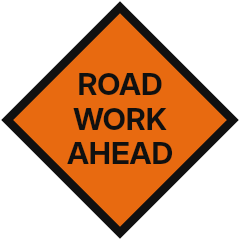
9. How should speed and following distance be adjusted beyond this sign?
Show answer
Answer D: Cut speed and leave a longer gap, because traffic can stop without warning
Traffic in these areas stops and starts unexpectedly and there is little room to steer around a problem, so extra space is what prevents a rear-end collision.
-
10. The word SCHOOL is painted in large letters across the roadway. What is it doing?
Show answer
Answer D: Backing up the signs marking a school zone
Word markings on the pavement reinforce a message that is already signed, and a driver looking at the road ahead cannot miss them.
-
11. A live power line is lying on your car and the car has caught fire, so you must get out. How should you leave it?
Show answer
Answer D: Jump clear without touching the car and ground at once, then shuffle away
Touching the vehicle and the ground together makes you the path to earth, and long strides can bridge the voltage spread through the ground.
-
12. After a crash your door will not open and you need to get out of the car. What should you try?
Show answer
Answer B: Try another door of the vehicle, or a window that will still open properly
A jammed door is common after an impact, and the simplest escape is a different door or a window rather than forcing the damaged one.
-
13. An oncoming vehicle at night has its high beams on and you are being dazzled. Where should you look?
Show answer
Answer A: Toward the right edge of your lane
Looking toward the right edge line keeps you on course while sparing your eyes the worst of the glare. Slow down and do not retaliate with your own high beams.
-
14. When does DC law require a child to travel in a rear-facing child restraint seat?
Show answer
Answer A: Under 2 years old and either under 40 pounds or under 40 inches
DC requires a rear-facing child restraint seat for a child under 2 years of age who weighs less than 40 pounds or measures less than 40 inches.
-
15. How much time does DC DMV allow for the GRAD or learner permit knowledge test?
Show answer
Answer B: 75 minutes
DC DMV allows 75 minutes for the GRAD or learner permit knowledge test.
-
16. For how long is a DC driver license revoked after a first driving under the influence conviction?
Show answer
Answer C: 6 months
DC DMV revokes the license for 6 months on a first DUI conviction and adds 12 points to the record.
-
17. What insurance document must be in the vehicle used for a DC road skills test?
Show answer
Answer B: An insurance card or policy that identifies the vehicle and shows the expiration date
DC DMV requires the test vehicle to carry a motor vehicle liability insurance card or the policy itself, identifying the vehicle and showing the expiration date.
-
18. Which activity does the DC definition of distracted driving expressly cover?
Show answer
Answer C: Personal grooming and interacting with pets or unsecured cargo
The DC definition covers inattentive driving caused by reading, writing, personal grooming, interacting with pets or unsecured cargo, or using personal communication technologies.
-
19. You are behind three slow vehicles on a two-lane road and the way ahead looks clear. What is the sound decision?
Show answer
Answer D: Pass one vehicle at a time, if the road allows it
Passing several vehicles in one move keeps you in the oncoming lane far too long and leaves nowhere to go if a vehicle appears.
-
20. On an undivided two-lane road you meet a school bus coming toward you with its red lights flashing and its stop arm out. What must you do?
Show answer
Answer C: Stop and wait until the red lights stop flashing
On an undivided road drivers in both directions must stop for a school bus loading or unloading, because children may cross in front of it.
-
21. Your loaded vehicle weighs more than the figure shown on a posted weight limit sign. What must you do?
Show answer
Answer D: Find another route, because crossing is not permitted
A posted weight limit is a legal maximum, not advice, so an overweight vehicle has to take a different route.
-
22. What distance must a DC driver leave when overtaking and passing a bicycle?
Show answer
Answer D: At least three feet
DC requires a driver to leave a safe distance, and in no case less than three feet, when overtaking and passing a bicycle.
-
23. Under the DC seat belt law, who has preference for seating positions fitted with belts?
Show answer
Answer D: Passengers aged 16 and under
DC requires the driver to ensure that children aged 16 and under get the belted seating positions ahead of older passengers.
-
24. Where is passing prohibited even when no line is visible?
Show answer
Answer D: On a curve or near the crest of a hill, at intersections and at railroad crossings
Passing is prohibited wherever your view of oncoming traffic is blocked or where vehicles may cross your path, which includes hills, curves, intersections and rail crossings.
-
25. What visual acuity in the better eye does DC DMV accept on its own, with no field of vision condition attached?
Show answer
Answer D: 20/40
DC DMV accepts 20/40 in the better eye, or 20/70 in the better eye combined with a field of vision of at least 140 degrees.