
District of Columbia DC DMV Permit Practice Test 8
Test 8 of 10. Pick an answer for each question to see if it is right and why; your score appears at the end. You need 20 correct answers to pass, the same ratio as the real District of Columbia test.

- Questions25
- Correct to pass20
- Passing score80%
- Minimum age16 years
-
1. What fine does DC set for exceeding the speed limit by up to 10 mph?
Show answer
Answer D: 50 dollars
The lowest DC speeding band, up to 10 mph over the limit, carries a 50 dollar fine.
-
2. What fine does DC set for failing to produce proof of insurance?
Show answer
Answer A: 30 dollars
Failing to provide proof of insurance is a 30 dollar infraction in DC, separate from the far larger penalty for having no insurance at all.
-
3. The divided highway ends warning sign means that
Show answer
Answer D: the median separating the directions ends and the road returns to two-way operation
Beyond this sign opposing traffic is no longer separated by a median, so the driver must keep right and expect vehicles approaching in the adjacent lane.
-
4. A freeway sign reads BUSES ONLY ON SHOULDER 6 AM TO 9 AM. Who may drive on the shoulder then?
Show answer
Answer A: Only the vehicles named on the sign, during the hours shown
Shoulder running is granted by the sign to the class of vehicle and the hours the sign names, and it does not turn the shoulder into a general travel lane.
-
5. What is the consequence of being caught cheating on a DC DMV knowledge test?
Show answer
Answer C: No retest for 60 days
An applicant caught cheating on the DC knowledge test cannot retest for 60 days.
-
6. A blue motorist service sign showing a fuel symbol and an arrow means that
Show answer
Answer D: fuel is available in the direction shown, and the sign imposes no obligation
Service signs are informational: they tell the driver what is available and in which direction, but they create no requirement.
-
7. You are driving down a parking aisle and reach the main lane that runs along the front of the store. What is the usual rule?
Show answer
Answer C: The main through lane has the right of way over the vehicles leaving the aisles
In a parking lot the wide lane that runs across the ends of the aisles works like a through road, and drivers leaving an aisle yield to it.
-
8. Along a highway the reference markers count upward as you travel. Where does the numbering normally begin?
Show answer
Answer C: At the southern or western edge of the state
Mileage numbering starts where the route enters the state from the south or the west, so rising numbers tell a driver which way they are heading.
-
9. Which ability does alcohol usually affect first?
Show answer
Answer A: Judgment and self control
Alcohol reduces judgment and inhibition before a drinker notices any clumsiness, which is why an impaired driver often feels perfectly capable while already driving worse.
-
10. How does DC treat a driver who holds up traffic by driving unreasonably slowly?
Show answer
Answer B: It is a moving infraction with its own fine
DC regulations set a minimum speed provision, and driving too slowly is ticketed as a moving infraction in its own right.
-
11. Besides a fine and points, what does DC law require of a driver convicted of aggressive driving?
Show answer
Answer C: Completion of an approved traffic school course within 90 days
Aggressive driving carries a 200 dollar fine and 2 points, and the driver must complete an approved traffic school course within 90 days or face suspension.
-
12. What must a DC driver do when an authorized emergency vehicle approaches using audible and visual signals?
Show answer
Answer C: Drive to the right-hand edge or curb, clear of any intersection, and stop until it passes
DC regulations require the driver to yield, drive parallel and as close as possible to the right-hand edge or curb, clear of any intersection, and stop until the emergency vehicle has passed.
-
13. Where is the no passing zone pennant sign installed?
Show answer
Answer A: On the left side of the roadway
The pennant is placed on the left side of the roadway at the beginning of the no-passing zone, in the field of view of a driver who is thinking about overtaking.
-
14. What must a DC driver obtain before taking a defensive driving course to remove points?
Show answer
Answer D: Prior written approval from a DC DMV hearing examiner
Points are only waived if a DC DMV hearing examiner approves the course in writing before the driver takes it.
-
15. What happens if a DC learner permit holder drives alone to the road skills test appointment?
Show answer
Answer A: The applicant cannot take the test for six months
Arriving without the required licensed driver bars the applicant from taking the road skills test for six months.
-
16. Who must wear a helmet when riding a bicycle in the District of Columbia?
Show answer
Answer D: Any operator or passenger under 16 years of age
DC makes a bicycle helmet mandatory for any operator or passenger under 16, and strongly recommends one for everybody else.
-
17. You have just returned to your own lane after passing. Why should you not slow down straight away?
Show answer
Answer A: The vehicle you passed is close behind and needs room to stop
Returning and then braking leaves the driver you just overtook with almost no following distance, which is how a pass turns into a rear-end collision.
-
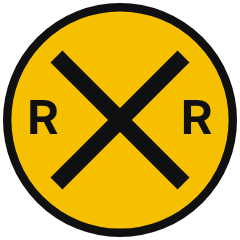
18. A driver sees this sign on a quiet road with no other traffic in either direction. What is the correct response?
Show answer
Answer C: Slow down, look and listen for a train, and be ready to stop
The sign gives advance notice of a highway-rail grade crossing, so the driver reduces speed, checks both directions along the tracks and keeps enough room to stop short of the rails.
-
19. How many points does DC assess for failing to yield to an emergency vehicle?
Show answer
Answer D: 6 points
The DC point chart assigns 6 points for failing to yield to an emergency vehicle, the same as reckless driving.
-
20. Why can a motorcycle ahead of you slow down without any warning light showing?
Show answer
Answer B: The rider may slow by downshifting or rolling off
Riders often lose speed by closing the throttle or changing down, which does not switch on the brake light, so watch the machine itself and keep back.
-
21. You are traveling beside a solid white lane line. What does it tell you?
Show answer
Answer B: Crossing it is discouraged or prohibited, so stay in your lane
A solid white line separates lanes going the same direction where lane changing is discouraged or prohibited, such as where a through lane meets a mandatory turn lane.
-
22. The trapezoid sign shape is associated with
Show answer
Answer C: recreational and cultural interest area signing
The trapezoid is used for recreational and cultural interest area guide signs and for national forest route markers.
-
23. What does DC require of a driver approaching a stationary authorized emergency vehicle?
Show answer
Answer B: Yield the right of way and proceed with due caution around it
DC regulations create a separate 100 dollar infraction for failing to yield the right of way and proceed with due caution around a stationary authorized emergency vehicle.
-
24. Halfway through a curve you realize you are going too fast. What is the best response?
Show answer
Answer C: Ease off the gas gently and look where you want to go
Easing off transfers a little weight to the front tires without upsetting the balance, and looking through the curve keeps your steering smooth.
-
25. A shared-use path crosses the road ahead at a marked crossing and people are already crossing on it. What should you do?
Show answer
Answer C: Yield and let them finish crossing the road
People already crossing at a marked crossing have the right of way, and a path crossing is a crossing of the roadway like any other.